Monday, March 19, 2012

Uncovering Gold


A visitor can receive an entire tour of the center without ever knowing these rooms exist. There are two of them. They are the Store Rooms. Upon first glance, you might think they are junk rooms, but after a little digging, it's really gold you've come across.

As you might know, our biggest project at the center right now is organizing the new library and store room. Most of my updates have been about the library because that was something we could do right off the bat. We were able to catalog all of the books the center owns to prepare them for the new check-out system. Over the past couple of weeks, a lot has happened at the center. The room for the new store was finally cleaned and prepared for us to begin moving everything in. While we were waiting on the finishing touches, we moved in all of the school supplies to the shelves in the side room. That only took a day and we hand counted everything, including over 3,000 pencils.

School Supplies

Last week we started organizing the upstairs store room, which looked like this:


We had a lot of work ahead of us, but we knew it had to be done. After some discussion on where to start, the work began. In this hot, congested room with no airflow, our plan was to separate all of the stuff into categories. There were basically 3 categories: clothing, shoes, and other. I thought the other pile would end up a lot bigger than it actually was, due to all of the stuff piled in this room. We used a large barrel-like container to collect all of the shoes. The large barrel wasn't big enough for all of the shoes. In fact, there was a whole other sack full of TOMS!
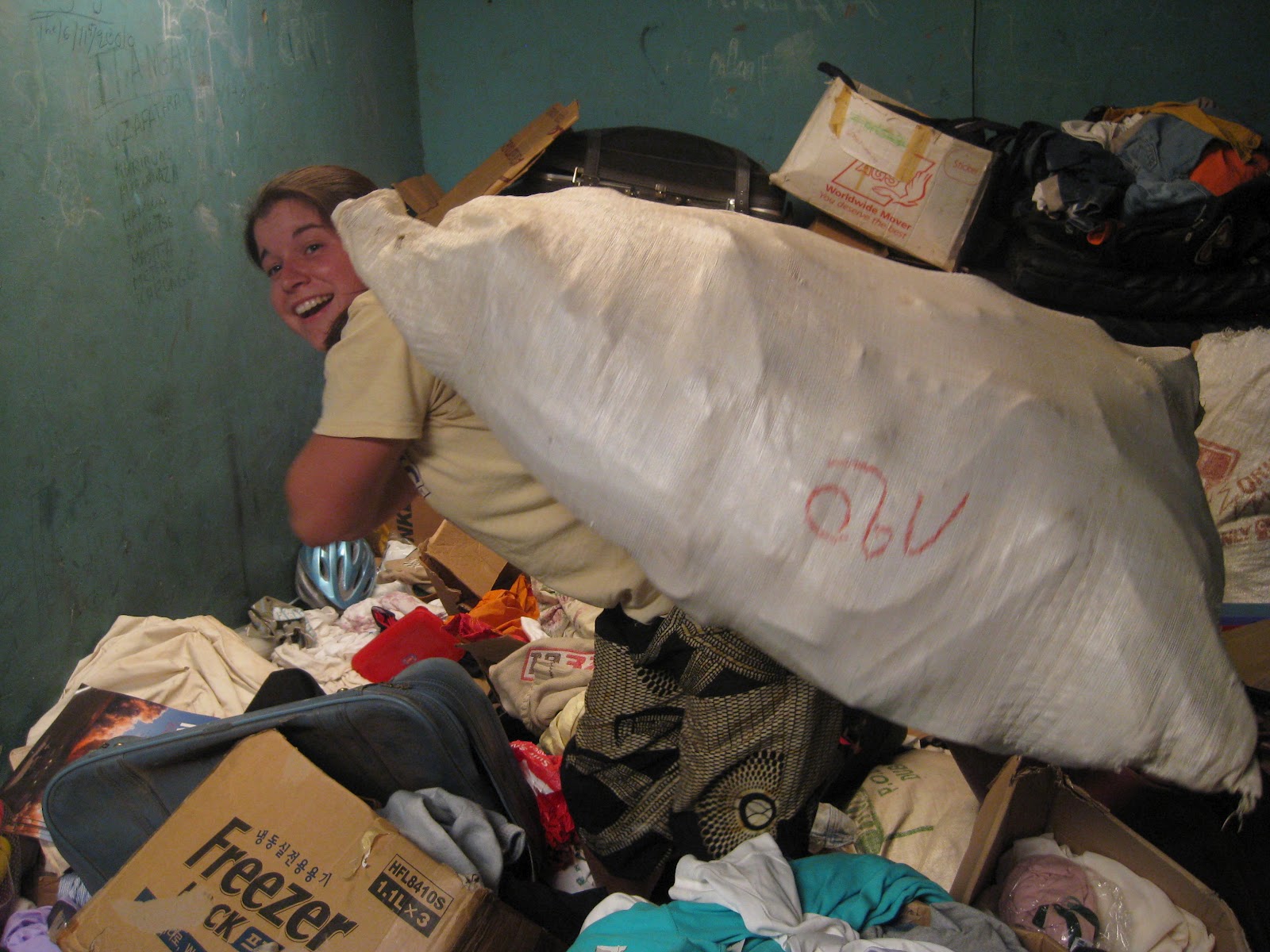
This wasn't all of the TOMS shoes.

Once we sorted out all the shoes, we cleared a space so we could have enough room to make neat, folded piles of all the clothing. We went through boxes, and boxes of used, and unused clothing. There were baby clothes, teenage girl clothes, very large man clothes, and a variety of practically everything you can think of.

After every article of clothing was sorted and folded. Plus I put on this nice outfit.
The process took 2 days, and we are currently in the middle of moving all of the sorted clothing into the new store room. That's where today began.

-----

It's Monday, and we arrived at the center at 9:45am. Like every other day we arrive at the center. We were greeted by a few girls who neighbor the area and go to class in P1 at the center, and Dariya, the cook's 3 year old daughter, although I'm sure she must be turning 4 soon. They came running at us the second we walked through the gates. They gave us big hugs, and after we asked them how they were, they responded with "We are fine." That's some of the very little English they understand, although Dariya understands a lot of what we say to her. 

After the welcoming greeting, we were excited to check out the library, as it recently received it's final paint job! It's blue, and it looks great. We then went into the new store room, where we found the floors clean and ready for us! The only thing we had to do before moving things in was wash the shelves that we were moving in to use.

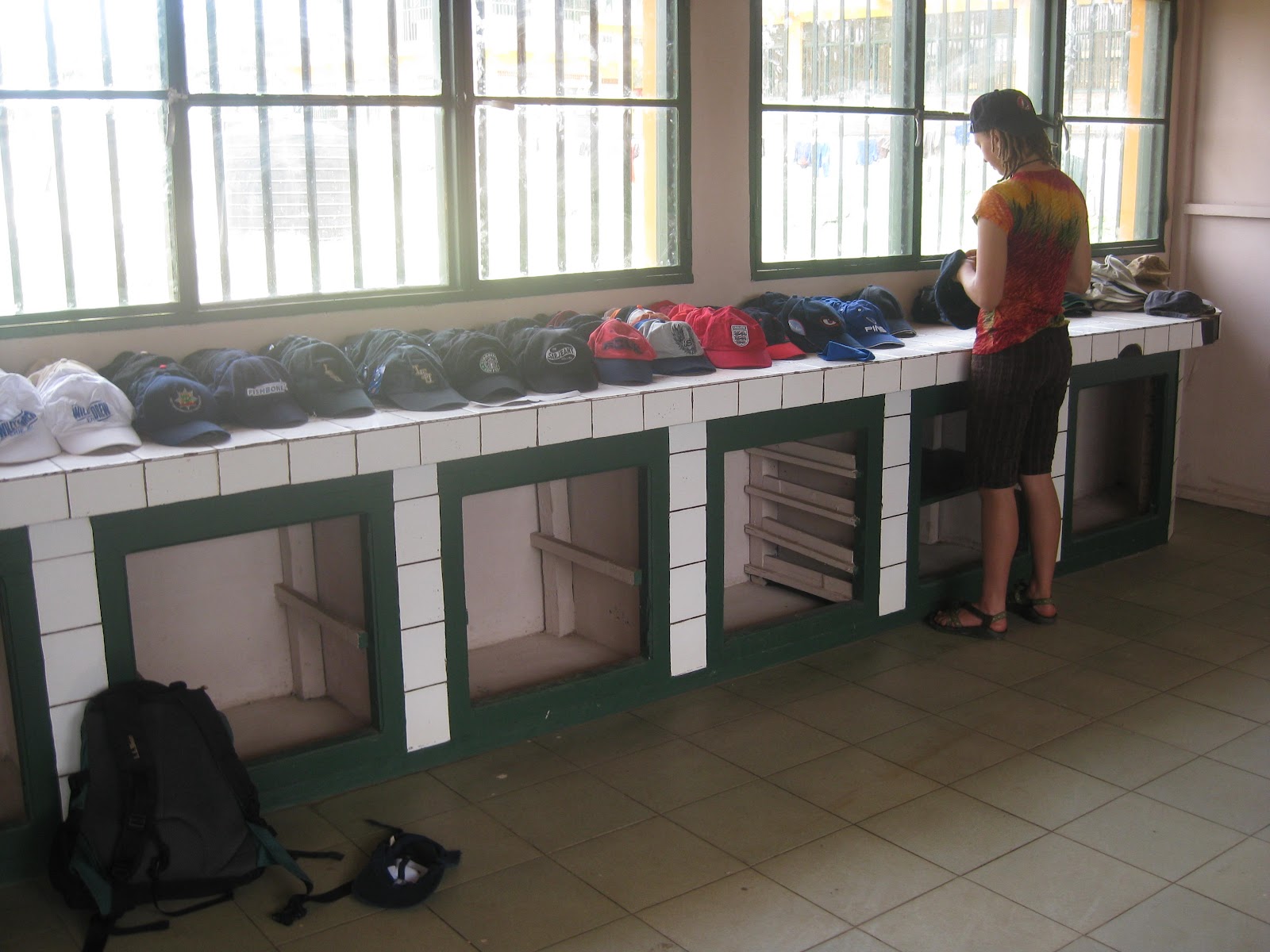
Once the store room was ready, we had to make another plan: How to transfer the clothing without causing too much of a scene. Since the younger boys were not in class, we wanted to transfer the hats first because they were in a large white sack. It would be impossible for the boys to know that this sack contained over 200 hats. We took them into the new store room, and dumped them all over the floor. Then we sorted through them until the boys had class again. 

Having some fun with all the hats!
Almost done sorting them.
It was time to move the clothes. This process was simple. Elena and I made a chain from the upstairs of the store room to the downstairs, where we would temporarily hold the clothing. Once our clean spot was filled, one person brought the piles from the old store room half way to the new store room, where the other person would be waiting to take it all the way to the new store room. This was to keep kids out of both buildings. We didn't have any help from the staff so we had to make sure everything was kept safe from sticky hands. As the piles began forming in the new store (which has clear glass windows all along both walls) the boys began watching. They saw all the hats, and all of the clothing. There was no more hiding the items of the store room. As we moved the clothing over, Agnes, the store keeper, took some soccer jerseys out of the downstairs store. She did this right before lunch, which was not the brightest idea because she then had to sit there with the jerseys and eat lunch so none of the boys would take them.

After lunch we moved all the jerseys to the new store. The upstairs also contained 4 or 5 practically full team sets of soccer jerseys, on top of the ones in the downstairs. As we began folding and sorting all the jerseys, the windows became full of faces. Boys were peering in with amazement at all the soccer jerseys we were dealing with. It was like we were watching us dig through a gold mine from the outside of an electric fence. I would estimate that we have about 175-200 soccer jerseys of all sizes at the center.

All the clothing and jerseys excluding the ones we pulled out to give away.
The exciting thing is that we are planning a give-away dance party on friday, where each boy will receive a glow stick (courtesy of Woonsocket High School), a pair of underwear (from Elena's Amazon Christmas drive), and a soccer jersey (hopefully). We will then hold a dance (with Willy as the DJ). It should be a really fun night, so hopefully all goes according to planned.

Things are finally on a fast track, and we are very excited that all of these donations that have been sitting around for a few years will finally be put to use. Stay tuned, as we are hoping to finish this whole project before we leave!

Saturday, March 10, 2012

A Mish-Mash of Things


This post will contain lots of bits of information. It's been a while, so I'm catching up!

The Harwood group just left after a three week stay in Rwanda. This was the same trip I was on in 2009 when I decided I had to return. We were very busy while they were here. We decided we wanted to be very involved with their activities because we could offer some different perspectives and help them with some ideas on how to manage various activities with 27 people not including the three of us and Gyslaine and Alexis, the group leaders. They spent their first week in Kigali working with some schools, including EDD! They also spent some time in the market. We introduced them to Josephine, our fabric lady. We helped them pick out fabrics, we gave them the prices, and helped to put back the fabrics that had been taken out. It was quite chaotic, but also really fun to be in the fabric business for an afternoon. Josephine was so grateful for all the business we brought her. 

Before leaving for the southern region of Butare, we visited a few genocide sites. The first was the Kigali Genocide Memorial, where 280,000 people are buried. Revisiting the museum brought a lot of emotion. The written stories of various victims went straight to my heart. The most difficult part was the children's room. The children's room contained enlarged photo's of children who were killed during the genocide. The photo's were the most recent of the child, and sometimes the only pictures their families had. Below each picture was a simple description of the child's favorite things, and how they were killed.

We also visited two churches that were attacked during the genocide and are now used as memorials. The first was Ntarama, and the second was Nyamata. I had visited them in 2009 and it was a very different feeling visiting these places again. Ntarama contained a coffin of a body that had been recovered just a week earlier. There were about 9 new coffins since the last time I was there. They are still finding bodies even 18 years later.


On the Monday before we left for Butare, the group came to EDD to do some projects. They primed the walls of the library, and began varnishing the outside walls of the dinning hall. They had plans to build some bookshelves for the new library, but we had some troubles getting all the supplies together in time. The good news is that we have all the materials now, and we can build them soon!


We were very busy in Butare. We took a tour of a few coffee washing stations, one of which is where Green Mountain Coffee Roasters buys beans for a seasonal roast. We also spend time with a group of coffee farmers. We worked along side them pulling weeds, talking, and dancing.


We also spend a few days at Burate High School. It is the top secondary school in the country. The students speak impeccable English. We were able to spend some good time getting to know some of the students. We talked with them about all sorts of things. Most of the time we compared the United States with Rwandan norms. From hanging out with friends, to Country laws. I learned so much from talking with these three young ladies. We also got to challenge some students to basketball and volleyball. We didn't have a chance to win, but it was fun anyway.


After time in Butare, we travelled west towards Lake Kivu, where we spent three nights. The food was delightful, and it was really relaxing to hop in the lake for a swim throughout the days and to have time to get some work done.

After Lake Kivu we travelled to the eastern side of Rwanda to Akagera National Park. Harwood had a grant that allowed them the opportunity to spend a night in Akagera and participate in a five and a half hour safari. We were lucky to be able to join them! It was such a neat experience. 


Spending time with the group was really fun. It gave me a lot of time to think about this country and it's history and the direction it's headed in. It brought many answers as well as many new questions. I loved getting to know the kids in the group and sharing the Rwandan experience with them. It was a really nice change of pace, and now I am energized to return to EDD and get to work in the store room!

A Journal Excerpt From March 1st


I wrote this entry the night after I revisited the most difficult and powerful genocide memorial site I've ever seen. The memorial is in Murambi, on top of a secluded hill holding the walls of classrooms and dormitories of an unfinished high school. About 50,000 people were killed here. The bodies were bulldozed into mass graves then covered to hide the evidence. A survivor, who escaped and hid in the bushes of a neighboring hill, saw what the perpetrators did with the bodies. If it weren't for him, they may have never found the mass graves of preserved bodies that now lay on tables within the walls of the classrooms they were killed in.

------

Translation: "If you knew me, and you knew yourself, you could not kill me."

Today my head reached a climax of questions. Most are questions that may never be answered. What is forgiveness? Why is it so easy for some yet so impossible for others? How do you truly know if someone has forgiven? Why does human existence have to include events that require forgiveness? I've heard so many stories from various Rwandans who experienced genocide first hand. With every story I've heard, the teller is in a different stage of forgiveness. Whether it be forgiveness because of fear, for the sake of God, or a true understanding and whole-hearted forgiveness, Rwandans are trying to forgive.

50,000 people were killed in Murambi. Among those people were Willy's immediate family members from his mom's side. I wish so badly to know all their stories, but they will remain untold. How did Willy and his mom survive? Where did they go? Why is it so easy for some people to talk about the events that took place during genicide while others are left utterly speechless. I can only imagine the kind of pain Willy's mom endured. I know she lost practically her entire family. She lost her husband and a child, Willy's twin. She was raped. The rape left her with a life-long illness of HIV. She will live with this haunting memory for the rest of her life. She knows who killed her family but cannot bare to tell Willy who. How does he continue on every day without knowing the answers? How is he so happy now even though he cannot forgive those who hurt his family? It is something I will always be curious about. 

How is it that people can live so close to such a retched smell? This horrendous smell of death lingers all day, every day. How do these women wake up every day and go out to their garden to work and see the school with open classroom doors filled with bodies, and smell this awful smell every day? There's no way these women were victims. There's no way they lived there during the attack on April 21st, 1994. How does anyone from that town continue on after the massive attack? When will the poisonings end? When will every Rwandan feel safe? The human being is remarkable. The mind has the potential to be so powerful, and so weak. The process of healing and forgiving go hand-in-hand. In order to heal, I believe that people have to prove themselves in order to receive forgiveness. Someone would have to prove to me that they are truly sorry. There's no way it could ever be possible over night. I believe the process of forgiveness takes years to accomplish. Support is a necessity during this process, whatever form it might come in.

The country of Rwanda is testing the power of humanity. It is the first country to endure a genocide, and coexist in the end. The next ten years will be extremely important and worth learning from. This outcome will heavily depend on the generation of youth right now. Their parents were filled with fresh memories of genocide during their childhood. How do they learn what really happened? Will these kids learn to constructively question authority and to question the information given to them? When will the titles of Hutu and Tutsi really disappear? When will they really be a thing of the past? Will these titles continue for the sake of story? Will the world ever have a handle over genocide or will it continue to strike other populations of the world? Why is it so difficult to prevent? Will there ever truly be peace everywhere?

Friday, February 24, 2012

The Market and More


It's been a long while since my last post, so maybe some of you are very curious as to what I have been up to! So, due to some housing issues, we moved into town. Town is the busy part of Kigali where all the big businesses are, and lots of people around all the time. We are living in the Sulfo compound. Sulfo Industries is the company owned by Faraz and his family who also own EDD. We were very excited to move because termites were migrating into our house, and that is never good. We also lost water very often, which sometimes made it difficult to cook and clean. We were very thankful for the water when we did have it. Our new house has been very comfortable and we are surrounded by very friendly people who have all been helping us out. There is one woman who works as the accountant at EDD, her name is Sangita and she is from India. Her family has warmly welcomed us and they continue to help us find super markets and vegetable markets close by. So far, living in town has been very convenient, although our commute to work is about 40 minutes.


Our new place!
The center is doing well. The library is practically ready to be painted! The Harwood school trip arrived on Tuesday, and they are planning to spend Monday at the center building book shelves, painting the library, and varnishing the outside of the dinning hall. We are very excited for their helping hands to join us!

We revisited some street boys from Remera a few days ago. We had met with them about a month ago to speak with them about what their lives are like on a day-to-day basis. You can read more about that visit here: Patience is a Virtue. This time around, we brought some hand-me-down long sleeve soccer jerseys which were donated by Elena's cousin. Please read about it here: Blue and White.

Ok, now for the market! Elena, Elizabeth and I visit the market on at least a weekly basis. You would think that by now I should have everything I need. There should be no need for me to have anything more to do with the fabrics at the market. Anyway, to make a long story short, Josephine and her fabrics are nothing short of addicting. I think I have only visit the market once without purchasing a piece of fabric. I have a stack of fabrics amongst my other articles of clothing that are still awaiting their opportunity to be transformed into something beautiful. Every time we go to the market, I bring one or two of my pieces. I always hope that my favorite seamstress, Chantal is there. She comes in and measures me for whatever article I am asking for. So far I have four skirts, two pairs of baggy capri's, two dresses, a shirt, a jacket, and a traditional Rwandan outfit. 

-----

It was a regular afternoon. We were on our way to the market on a wednesday after work to pick up some of our clothes we had left a few days earlier for alterations. It was hot, but not too hot. We arrived at Josephine's fabric stand to see if our things were ready. She greeted us with her usual "Hi, my sista."We tried on our clothing and found a few things still needed some changes. As we were waiting, I noticed her mannequin had a new outfit. It was a green traditional outfit that looked like it would fit me. I noticed a lot of things I liked about the shirt. The stitching was impeccable, and the lines were beautiful.

I like to make Josephine laugh, often, and in many different ways. There is usually music playing, so I tend to dance a lot. Other times I just say funny things. This time, I decided to surprise her. She was gone to check on our clothing, and I decided to undress the mannequin. The shirt landed over my own, and I sat on the counter like everything was normal. When she walked in, she began laughing. After a short while, she said I looked "so good." Then the long skirt found it's way around my waist. I walked out of her booth into the open court yard that is surrounded by other booths. Many people began to laugh and say "you look so smart." We sat around for a while as we waited. The outfit totally grew on me, and the decision was made quite clear in my head that this outfit would be mine, and I would pay 15,000 Rwandan Francs ($25) to keep it. 
Me and Josephine
The shirt was taken back for some alterations to make sure that it fit me perfectly. A zipper was added so I could easily fit it over my shoulders, and would zip up to fit like a glove.

Just as I though we were almost ready to leave, Josephine told me I forgot something. How could we forget about the head piece?! Josephine handed one of the seamstresses the remaining piece of fabric, and she began to drape it around my head, making sure it stood high into the air. I took another walk out to the court yard, and received many thumbs up and some applause, so I took a bow.


My journey wasn't about to come to an end. We still had a few things to do before returning home. The first on the list was traveling to Willy's house to meet his mom for the first time. We left the market and walked about a mile to reach the bus station. I have never been stared at so much in my lifetime. "You look smart" echoed my path as I made my way down the road. Apparently that means I look well-dressed. As we neared the gates of the bus station, the line of moto guys all stood up and began clapping (Willy's mom enjoyed hearing that story later on).

I suppose for many, or maybe all of the people I passed, I was the first white person to be out in a traditional Rwandan outfit. Many thought it was funny, and others appreciated my new look.


When we got to Willy's neighborhood, we were excited to see the look on his face. We saw him about a hundred meters down the road, stopped frozen in his footsteps with his hands over his mouth. He was shocked and absolutely loved it.

Willy's reaction...
Anyway, it was a pretty funny evening, and it was so nice to finally meet Willy's mom. She has been very sick lately and is recovering from a fall she took not too long ago. It was really nice talking with her and giving her something to laugh about. 

Mama Willy made sure she put her head piece on for the picture too
One last thing, Willy began secondary school last monday, and upon his first visit to a basketball practice, he made the team! They won their first game that Willy played in, and he had 9 points for the team who would win by 13 points!

Wednesday, February 15, 2012

Anything Can Happen in Football


Many changes have been occurring at the center. The ministers have been granted their power back, and there is a forcefield of happiness from the boys that spans the center. You can read more about the root of the events here: Elena's blog

As I have mentioned in previous posts, we have been working very hard with our class on respect and listening. We know their favorite game to play is football (soccer) and that is what they've been waiting for ever since we started the class.

This week, we planned to introduce the footballs. It has been something we have been working towards for four weeks now. On monday we re-explained the game of blob tag. We explained the steps very slowly through speaking using our vocabulary words, and through acting. To our surprise, they followed almost all the rules of the game, and practically everyone was wearing a smile. Since the game went so well, we had some spare time at the end of class. We decided to set up a relay race. We made two teams and had each kid hop on one foot to the end of the basketball court and back, where they would tag the next person to go. The team that finished first were the champions!

Part way through the relay, Elena came to me with a brilliant idea. This is how we would introduce the footballs. They understood how the activity would work, and everyone would have an equal amount of time with a ball. Since we had already planned an art day on Tuesday, we would introduce the footballs on Wednesday.

Tuesday came, and we made baggies of crayons for each table. We decided that there would only be six to a table to eliminate arguing over colors. To begin we gave each table one of our vocabulary notecards that had the word in English and Kinyarwanda, accompanied by a picture describing the word. The kids were to draw their version of the word, and on the back create whatever drawing they wanted. Many of them attempted drawing the same picture that was on the cards we passed out, but they were all different colors and all unique. They also each got a sticker, which they could incorporate into their drawing, or put somewhere else. Many of them attempted to draw what was on the sticker they received. They enjoyed having the freedom to use the crayons, which they normally don't get to use on a daily basis.


Finally, Wednesday rolled around. We had to strategize how we would transport the footballs without any of the kids seeing. We had to do this because if these kids saw the balls, they would completely disregard anything coming out of our mouths. We found a small duffel bag in the volunteer room, which would fit three of the four footballs. The other one was put in my green bag, along with the cones. We transported the balls from the teacher's room to the volunteer room while the kids were still in class. We had the teachers tell the kids to meet us on the basketball court. After some planning for the store room and a quick meeting with Rafiki, we brought the bags out to the basketball court. We set up cones for four relay teams; one cone on one end, and another on the far end. We planned to do a few different relay races, so we placed extra cones on top of each first cone.

To begin, we gathered the class on a grassy patch next to the court. We waited for everyone to be quiet, and began to explain. Since we had already worked with the concept of a relay race, it was a fairly quick explanation and demonstration. In order to keep their attention, we brought out a hackie sack. The hackie sack was exciting for them, and it helped them understand the concept of waiting for the person to get back with the hackie sack before the next person could go.

We split our class into four teams. There were some even numbers, but it didn't really matter to them. The first person on each team was handed a hackie sack. I said "ready, set, GO" and blew my whistle. The race went well. We gathered the boys' attention and explained to them we are going to use footballs. You should have seen the look on their faces. I walked over to my bag and pulled out the first ball. Our class, wearing huge smiles, began clapping. Elena pulled out the other three, and they were all so excited. Some were yelling out "Ahhh thank you!!" We told them to keep good manners and we would be able to use the footballs more. They were so well behaved, it made me speechless.


After one round of down and back, I put four cones between the first and last. The boys were to dribble through the cones in control. Every one of the boys kept their smiles on for the rest of class. With fifteen minutes left before lunch, I gathered teams one and two together, and three and four together. I told teams one and two to defend one goal, and three and four to defend the other. Once again, the boys let out noises of pure happiness and excitement. The boys took off running to the football pitch. There was no order of positions or anything, but it didn't matter. I went to the middle of the pitch with one ball and kicked it straight into the air. They were off.

One boy had a whistle, and he designated himself as the referee. He called corner kicks, goal kicks, and throw-ins, but no fouls. Anything goes in this game of football. The boys traveled with the football in what seemed like a flock of geese. There was passing, but for the most part, the game was very back and forth and every man for themselves. Each team had a goal, and they were both celebrated as you see in the World Cup, or other big football matches. One of the P2 boys, Renee, celebrated with a roundoff back-handspring.
Our referee!

A corner kick that would result in a goal for team one-two


Towards the end of class, I began to wonder how to stop the game and collect the ball once again. We figured we'd blow the whistle and hope for the best. If worst came to worst, I'd be the one to chase the ball down. The time came, and I blew the whistle three times, as you would hear at the end of any football match. Everyone stopped and looked. The boy who had the ball last calmly walked over and handed me the ball, and the boys were off to lunch. Anything can happen in football.

A Rwandan Valentine's Day


If it hadn't been for Claire, our houseworker, I never would have known Valentine's Day was quickly approaching. We came home from work on the 13th to our walls decorated in flowers with notes attached. This was my first reminder that the following day would be Valentine's Day.


This has been the most powerful Valentine's Day of my life. In Rwanda, it was explained to me that Valentine's Day is really only celebrated by couples. For most of the country, it isn't celebrated at all. Since Rwanda isn't such a materialistic society, Valentine's Day has a whole other meaning.

This year, I have not been surrounded by the materialistic advertisements, as everyone in the United States has. I have been lucky to miss out on the constant reminder from television and radio advertisements about Valentine's Day sales for that special someone over the past month. There has been no Valentine's Day fundraisers, no chocolates, no carnations, no roses, no cards, no jewelry. Just love, in it's simplest form.

When I was talking about this large difference with Willy, he was quick to say "no, I will get you a card, I promise!" I hadn't seen any Valentine's Day cards anywhere really, so I wasn't expecting anything Hallmark. But, to my surprise, he showed up to our house on the evening of Valentine's Day with small flowers for each of us that came with a note saying "I love you" in several different languages. He also brought a card. It was covered in plastic. He gave it to me and said, "I told you I'd get a card!" Since it was still wrapped in plastic, he hadn't wrote in it, signed it, or anything. When I showed him that the plastic was meant to be removed so you can write in it, he was surprised. He had no idea the card came with an envelope inside. After showing this to him, he signed his name at the bottom and gave it to us. It was the sweetest thing.

Willy reading the card we made for him.

Friday, February 10, 2012

How Would You Feel?


I was a senior in high school, and driving down the roads of Rwanda for the first time. I had heard of the infamous Kinyarwandan word "muzungu" meaning "white person." I was excited to hear it called out as our buss full of muzungu's traveled down the road. Everyone in our group had heard it called out already, and I still hadn't heard the exciting phrase. I finally heard the word called out, and it was a very young little boy who went running down the sidewalk as if he wanted to catch up with the speeding bus. "HEY, A MUZUNGU!" I threw my head out the window and waved, wearing a huge smile on my face. I thought it was so cute to hear this word called out by this little boy, and every time I heard the word, I smiled. I never thought of what the word really meant. I remember feeling sort of like a celebrity because everywhere we went we would hear this word called out with a sense of excitement and happiness. 

As three years pass,  I have had a lot of time to think about my experiences from 2009. One of the things that would always get to me was a feeling of arrogance. I remember always having my head out the window during almost every bus ride. I would be waving to everyone, and some, but not all, would wave back. I began to feel unhappy with my actions in 2009. I wish I acted like any normal person from the country would act while driving along in a bus. Yes, waving is friendly, but why did I have to wave to everyone everywhere I went? Why did I coax out the word "muzungu" by everyone possible?


During one of my long chats with Willy a few days ago, we talked about what it means to be called "muzungu." He asked me if I liked it or not, and I replied "no." I added "how would you like it if you came to Vermont, and everyone just called you 'black person?'" He said he would hate it. He told me that a few years ago, he realized the segregation and negative notions the word muzungu has. He understood how it would make him feel if he was white. Since his realization, he never called a white person "muzungu" again. He tells me that whenever he hears a child call a white person "muzungu," he gives them the "how would you feel?" talk if he had the time. He hates that phrase just as much as I do.

Race is something our country has battled in it's recent history. As a student in the education department, I have learned the importance of multicultural education and equality. I have learned to treat every person equally. It doesn't matter if you are a man, woman, black, caucasian, asian, indian, gay, straight, tall, short, fat, skinny, shy, or outgoing. In Vermont I feel like I fit in with the culture and with the people around me, but it's not because they are white. I feel that it is because I was raised to treat everyone equally. Everyone looks the same underneath their skin.

Upon returning from my recent trip to Uganda, I found myself questioning the phrase again. How is it that "muzungu" is one of the only words that a Rwandan two year old knows? Children always know the phrase "muzungu, give me money" whether they know english or not. This phrase is used by the young, the old, the rich, and the poor. It feels like it comes out of their mouths because it is a habit. Even if they really don't need money. What does it mean to be a "muzungu" aside from the color of your skin anyway?

In Rwanda, and in many other African countries, white people are looked at very differently than the rest of the population. They are often travelers, so they are the ones who have money. They come to aid and educate. They feed the poor. They caused the extreme divisions between poverty and wealth. They have the power to cause animosity and hate among people within a country. White people who have come into this country of Rwanda in the past have come in for reasons of power. Division between white and black is so obvious in this country. There is absolutely no way for me to blend in with the rest of the people here. Even if I had all the same beliefs as them. Even if I lived here in a small house with no running water or electricity my whole life, I would never blend in. I will always be a muzungu. A muzungu with all the stereotypes attached.

There are definitely times I wish I was black here. Simply for the ease of moving around in the market, or going for a run down the street, or catching a bus to or from town. Even though bus fares are a set cost and they can't charge anyone more, the bus drivers still go out of their way to call you over just because you are white. Sometimes I am embarrassed because I am white, only because I know of all the stereotypes that come along with the color of my skin. We are all the same to them. We are all tourists out to spend money in every way possible. We have the spare change to take a bike taxi for a mile instead of walking. We can afford to be charged double for a moto ride. We can afford to walk into a market and mildly bargain down to a price nearly double the actual cost. But really, I'm not rich by any means, and I can't afford any of these extra expenses. I can't be taken advantage of in these ways. I am here to expand my views, education, and understanding of world issues. I am here to make a positive impact on children's lives. I am here to learn from them just as they are learning from us. I am not a piggy bank for anyone to break into.

Now, when I hear the word "muzungu," I feel disappointed and frustrated. Why do I have to be called white person, even by adults? What is it that white people do over and over again that keeps the phrase "muzungu, give me money" alive? What can be done to eliminate this phrase? Why can't I just be another person walking down the street? How would you feel?