Wednesday, February 15, 2012

Anything Can Happen in Football


Many changes have been occurring at the center. The ministers have been granted their power back, and there is a forcefield of happiness from the boys that spans the center. You can read more about the root of the events here: Elena's blog

As I have mentioned in previous posts, we have been working very hard with our class on respect and listening. We know their favorite game to play is football (soccer) and that is what they've been waiting for ever since we started the class.

This week, we planned to introduce the footballs. It has been something we have been working towards for four weeks now. On monday we re-explained the game of blob tag. We explained the steps very slowly through speaking using our vocabulary words, and through acting. To our surprise, they followed almost all the rules of the game, and practically everyone was wearing a smile. Since the game went so well, we had some spare time at the end of class. We decided to set up a relay race. We made two teams and had each kid hop on one foot to the end of the basketball court and back, where they would tag the next person to go. The team that finished first were the champions!

Part way through the relay, Elena came to me with a brilliant idea. This is how we would introduce the footballs. They understood how the activity would work, and everyone would have an equal amount of time with a ball. Since we had already planned an art day on Tuesday, we would introduce the footballs on Wednesday.

Tuesday came, and we made baggies of crayons for each table. We decided that there would only be six to a table to eliminate arguing over colors. To begin we gave each table one of our vocabulary notecards that had the word in English and Kinyarwanda, accompanied by a picture describing the word. The kids were to draw their version of the word, and on the back create whatever drawing they wanted. Many of them attempted drawing the same picture that was on the cards we passed out, but they were all different colors and all unique. They also each got a sticker, which they could incorporate into their drawing, or put somewhere else. Many of them attempted to draw what was on the sticker they received. They enjoyed having the freedom to use the crayons, which they normally don't get to use on a daily basis.


Finally, Wednesday rolled around. We had to strategize how we would transport the footballs without any of the kids seeing. We had to do this because if these kids saw the balls, they would completely disregard anything coming out of our mouths. We found a small duffel bag in the volunteer room, which would fit three of the four footballs. The other one was put in my green bag, along with the cones. We transported the balls from the teacher's room to the volunteer room while the kids were still in class. We had the teachers tell the kids to meet us on the basketball court. After some planning for the store room and a quick meeting with Rafiki, we brought the bags out to the basketball court. We set up cones for four relay teams; one cone on one end, and another on the far end. We planned to do a few different relay races, so we placed extra cones on top of each first cone.

To begin, we gathered the class on a grassy patch next to the court. We waited for everyone to be quiet, and began to explain. Since we had already worked with the concept of a relay race, it was a fairly quick explanation and demonstration. In order to keep their attention, we brought out a hackie sack. The hackie sack was exciting for them, and it helped them understand the concept of waiting for the person to get back with the hackie sack before the next person could go.

We split our class into four teams. There were some even numbers, but it didn't really matter to them. The first person on each team was handed a hackie sack. I said "ready, set, GO" and blew my whistle. The race went well. We gathered the boys' attention and explained to them we are going to use footballs. You should have seen the look on their faces. I walked over to my bag and pulled out the first ball. Our class, wearing huge smiles, began clapping. Elena pulled out the other three, and they were all so excited. Some were yelling out "Ahhh thank you!!" We told them to keep good manners and we would be able to use the footballs more. They were so well behaved, it made me speechless.


After one round of down and back, I put four cones between the first and last. The boys were to dribble through the cones in control. Every one of the boys kept their smiles on for the rest of class. With fifteen minutes left before lunch, I gathered teams one and two together, and three and four together. I told teams one and two to defend one goal, and three and four to defend the other. Once again, the boys let out noises of pure happiness and excitement. The boys took off running to the football pitch. There was no order of positions or anything, but it didn't matter. I went to the middle of the pitch with one ball and kicked it straight into the air. They were off.

One boy had a whistle, and he designated himself as the referee. He called corner kicks, goal kicks, and throw-ins, but no fouls. Anything goes in this game of football. The boys traveled with the football in what seemed like a flock of geese. There was passing, but for the most part, the game was very back and forth and every man for themselves. Each team had a goal, and they were both celebrated as you see in the World Cup, or other big football matches. One of the P2 boys, Renee, celebrated with a roundoff back-handspring.
Our referee!

A corner kick that would result in a goal for team one-two


Towards the end of class, I began to wonder how to stop the game and collect the ball once again. We figured we'd blow the whistle and hope for the best. If worst came to worst, I'd be the one to chase the ball down. The time came, and I blew the whistle three times, as you would hear at the end of any football match. Everyone stopped and looked. The boy who had the ball last calmly walked over and handed me the ball, and the boys were off to lunch. Anything can happen in football.

A Rwandan Valentine's Day


If it hadn't been for Claire, our houseworker, I never would have known Valentine's Day was quickly approaching. We came home from work on the 13th to our walls decorated in flowers with notes attached. This was my first reminder that the following day would be Valentine's Day.


This has been the most powerful Valentine's Day of my life. In Rwanda, it was explained to me that Valentine's Day is really only celebrated by couples. For most of the country, it isn't celebrated at all. Since Rwanda isn't such a materialistic society, Valentine's Day has a whole other meaning.

This year, I have not been surrounded by the materialistic advertisements, as everyone in the United States has. I have been lucky to miss out on the constant reminder from television and radio advertisements about Valentine's Day sales for that special someone over the past month. There has been no Valentine's Day fundraisers, no chocolates, no carnations, no roses, no cards, no jewelry. Just love, in it's simplest form.

When I was talking about this large difference with Willy, he was quick to say "no, I will get you a card, I promise!" I hadn't seen any Valentine's Day cards anywhere really, so I wasn't expecting anything Hallmark. But, to my surprise, he showed up to our house on the evening of Valentine's Day with small flowers for each of us that came with a note saying "I love you" in several different languages. He also brought a card. It was covered in plastic. He gave it to me and said, "I told you I'd get a card!" Since it was still wrapped in plastic, he hadn't wrote in it, signed it, or anything. When I showed him that the plastic was meant to be removed so you can write in it, he was surprised. He had no idea the card came with an envelope inside. After showing this to him, he signed his name at the bottom and gave it to us. It was the sweetest thing.

Willy reading the card we made for him.

Friday, February 10, 2012

How Would You Feel?


I was a senior in high school, and driving down the roads of Rwanda for the first time. I had heard of the infamous Kinyarwandan word "muzungu" meaning "white person." I was excited to hear it called out as our buss full of muzungu's traveled down the road. Everyone in our group had heard it called out already, and I still hadn't heard the exciting phrase. I finally heard the word called out, and it was a very young little boy who went running down the sidewalk as if he wanted to catch up with the speeding bus. "HEY, A MUZUNGU!" I threw my head out the window and waved, wearing a huge smile on my face. I thought it was so cute to hear this word called out by this little boy, and every time I heard the word, I smiled. I never thought of what the word really meant. I remember feeling sort of like a celebrity because everywhere we went we would hear this word called out with a sense of excitement and happiness. 

As three years pass,  I have had a lot of time to think about my experiences from 2009. One of the things that would always get to me was a feeling of arrogance. I remember always having my head out the window during almost every bus ride. I would be waving to everyone, and some, but not all, would wave back. I began to feel unhappy with my actions in 2009. I wish I acted like any normal person from the country would act while driving along in a bus. Yes, waving is friendly, but why did I have to wave to everyone everywhere I went? Why did I coax out the word "muzungu" by everyone possible?


During one of my long chats with Willy a few days ago, we talked about what it means to be called "muzungu." He asked me if I liked it or not, and I replied "no." I added "how would you like it if you came to Vermont, and everyone just called you 'black person?'" He said he would hate it. He told me that a few years ago, he realized the segregation and negative notions the word muzungu has. He understood how it would make him feel if he was white. Since his realization, he never called a white person "muzungu" again. He tells me that whenever he hears a child call a white person "muzungu," he gives them the "how would you feel?" talk if he had the time. He hates that phrase just as much as I do.

Race is something our country has battled in it's recent history. As a student in the education department, I have learned the importance of multicultural education and equality. I have learned to treat every person equally. It doesn't matter if you are a man, woman, black, caucasian, asian, indian, gay, straight, tall, short, fat, skinny, shy, or outgoing. In Vermont I feel like I fit in with the culture and with the people around me, but it's not because they are white. I feel that it is because I was raised to treat everyone equally. Everyone looks the same underneath their skin.

Upon returning from my recent trip to Uganda, I found myself questioning the phrase again. How is it that "muzungu" is one of the only words that a Rwandan two year old knows? Children always know the phrase "muzungu, give me money" whether they know english or not. This phrase is used by the young, the old, the rich, and the poor. It feels like it comes out of their mouths because it is a habit. Even if they really don't need money. What does it mean to be a "muzungu" aside from the color of your skin anyway?

In Rwanda, and in many other African countries, white people are looked at very differently than the rest of the population. They are often travelers, so they are the ones who have money. They come to aid and educate. They feed the poor. They caused the extreme divisions between poverty and wealth. They have the power to cause animosity and hate among people within a country. White people who have come into this country of Rwanda in the past have come in for reasons of power. Division between white and black is so obvious in this country. There is absolutely no way for me to blend in with the rest of the people here. Even if I had all the same beliefs as them. Even if I lived here in a small house with no running water or electricity my whole life, I would never blend in. I will always be a muzungu. A muzungu with all the stereotypes attached.

There are definitely times I wish I was black here. Simply for the ease of moving around in the market, or going for a run down the street, or catching a bus to or from town. Even though bus fares are a set cost and they can't charge anyone more, the bus drivers still go out of their way to call you over just because you are white. Sometimes I am embarrassed because I am white, only because I know of all the stereotypes that come along with the color of my skin. We are all the same to them. We are all tourists out to spend money in every way possible. We have the spare change to take a bike taxi for a mile instead of walking. We can afford to be charged double for a moto ride. We can afford to walk into a market and mildly bargain down to a price nearly double the actual cost. But really, I'm not rich by any means, and I can't afford any of these extra expenses. I can't be taken advantage of in these ways. I am here to expand my views, education, and understanding of world issues. I am here to make a positive impact on children's lives. I am here to learn from them just as they are learning from us. I am not a piggy bank for anyone to break into.

Now, when I hear the word "muzungu," I feel disappointed and frustrated. Why do I have to be called white person, even by adults? What is it that white people do over and over again that keeps the phrase "muzungu, give me money" alive? What can be done to eliminate this phrase? Why can't I just be another person walking down the street? How would you feel?

Thursday, February 9, 2012

Run Forest, RUN!

I've been here for three weeks now, and things have been going great! I have a new addiction for fabric shopping (I am trying to quit) and a brand new hair style that I plan to keep around for a solid chunk of time. Also, things are coming along with the library project! We've begun cataloging all the books by genre and ability, and it is taking a lot of time. Rafiki gave us 100% control over the library project, and the store room project as well! That is great news because the only thing we have to wait for is the completion of the construction. Our English/PE class improves every day! They are beginning to realize that they get to play more games when they listen to, and follow directions. We add more vocabulary words every week, and they are starting to understand the rules of tag. The biggest hurdle of tag we are beginning to get over is "no puppy guarding."


 While we are working with the boys on their English skills, we are also teaching them games that we hope will stick around the center for years to come. Exercise is something that naturally occurs throughout the life of a Rwandan. Exercise isn't something they have to go out of their way to accomplish. Elena and I have been on a few runs together, and it's been awesome. Despite it's awesomeness, it's also made me think about America's  customs of exercise. Seeing someone running purely for exercise is a normality within the borders of the United States and other advanced, westernized countries.

Being white in this country makes you stand out a lot. Practically everywhere we go we hear "muzungu" (meaning white person) yelled out at least once. Now imagine what it would be like to see a parade of circus clowns wandering down main street. We get similar crowds when we go running down the streets of Rwanda.


-----


It was a warm afternoon, around 4:30. Elena and I planned on running when we got home from work. Our walk home is all uphill, and we are normally in a solid sweat by the time we reach our gate, which is sometimes very difficult to open. It was a tough day at the center, and we were feeling pretty fried. As I lay on the couch, Elena walks into the living room all dressed in running attire. "I suppose this means I should go get dressed, huh?" I mention.

As I lace up my shoes, I begin to get excited for some exercise. I pull back my new dreadlocks with an elastic headband, and we're off.

We decide to run 15 minutes out and turn around. We've had a long day, and this should be all we need to get out blood flowing. We run up our rain-damaged dirt road to a main road. We instantly draw the eyes of anyone in our sight. As we travel down the sidewalk, we begin to notice the local children peaking outside their gates. Of course they yell out "A MUZUNGU!" We pass off a wave and move on.

We pass through multiple bus stops, occupied by people of all sorts including a few moto guys here and there. They are normally the ones who crack some joke in Kinyarwanda, making others around laugh and stare. We keep going. We hear conversation from people we pass. They give away their subject when we hear them say "muzungu" amongst a slew of words we don't recognize.

As we come to our 15 minute turn-around, I'm feeling good. We have traveled about a mile and a half from our home. Shortly after our turn-around, a man with clunky rain boots runs in front of us. We look at each other with a face that clearly says, "he's crazy!" He throws his hands up in the air as if he is dancing in celebration as he continues to run in front of us. We assume he is umusazi (crazy) or just drunk. Surely he'll tire in either case and stop to let us continue on our way. He begins to slow down, and just when we think he's had enough, he glances over his shoulder and jolts ahead again. He does this one more time, and this time I get the whiff. I turn my head towards Elena and say "He's drunk."

Our drunken tag-along creates even more of a scene. More people laugh. As we near the turn for our street, we begin to strategize about how we are going to make this turn without him noticing. To avoid a drunken man knowing where we live, we decide to slow down a little before our street. As soon as we round the corner, we lengthen our stride and fly down the hill of our street. We look back and see nothing. The plan worked, and we cruise down to our house with no one following.

We reach our gate, and it opens with no trouble. We instantly begin to laugh about our whole experience. With sweat dripping from our faces, we finish up with some sets of push-ups and sit-ups to round off our exercise. No three mile run in the United States could ever be as eventful as this one.

Monday, January 30, 2012

NUMBERED LISTS

1- Yes, Elena LOVES making lists (this post is in her honor).

2- We started our Physical Education/English class. The first day was rather hectic to say the least. We don't have a classroom big enough to fit all the students from both Primary 1 and Primary 2 (grades 1&2). We thought it would be no problem to gather the boys on the basketball court for the first class. We quickly discovered that discipline is practically nonexistent outside the walls of a classroom. It took us about 15 minutes to get everyone gathered together and mildly quiet. After attempting to teach them a simple one-on-one game, we realized that much of what we were trying to teach them went straight over their heads. All they wanted to do was play football (soccer) and many of them were refusing to participate because we weren't playing what they wanted. The next day we decided to make the dining hall our class meeting place. Although this was certainly not a classroom, it was far more fit for the class than the open outdoors. We arranged a few rows of benches in one part of the dining hall to allow the boys to have an orderly way to sit. We hoped this would remind them more of a classroom setting than the basketball court did. In the dining hall we went over some english vocabulary words that related to the rules we created as a class, and to the games we played that day. With the help of one of the classroom teachers, we were able to make it clear to the boys that we would not be playing football until we could see that the class could listen and follow directions. We also told them that if they don't participate in the activities we are doing now, they would not be able to participate when we do play football. After this pep-talk, they were more into the new games we were teaching them. We also taught them how to respond when we want their attention. We give two whistles for everyone to stop what they are doing, then we add "1, 2, 3, eye's on me." This is a classic command we learned in elementary school that always works, and the students are very quiet after responding with "1, 2, eye's on you." The following day we walked by one of their classrooms before the teacher had arrived, and we heard all the boys yelling "1, 2, eye's on you!" We accomplished the task of gaining attention when attention gaining is needed. Tag is a whole new battle that we have begun to tackle. We're still trying to help them understand that you don't want to be tagged, and that it's not okay to "puppy-guard."

3- We have Vermont Turkey posters hanging on our walls. Elena found them in the store room at EDD. 


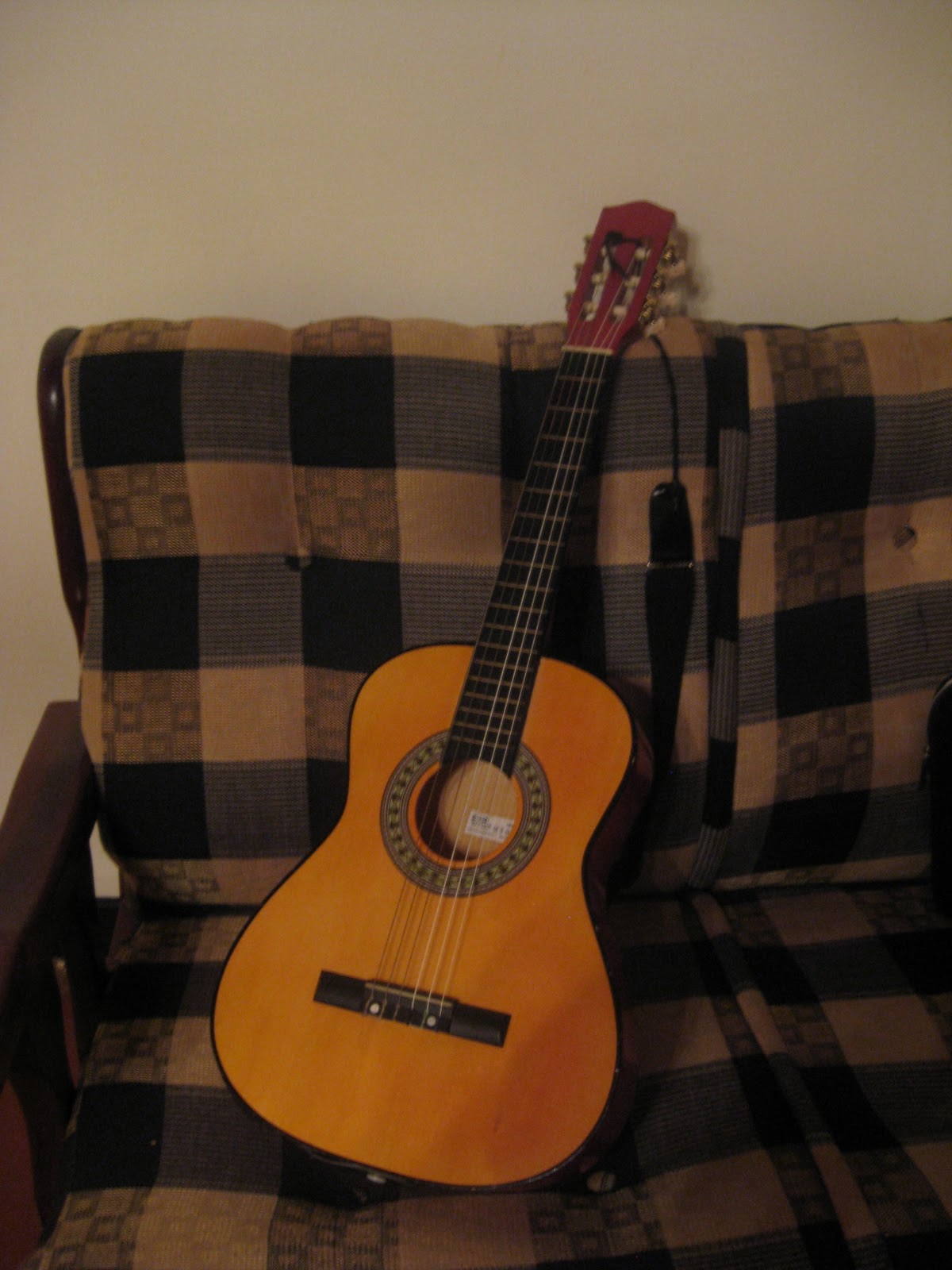
4- I've been playing a guitar that I'm borrowing from the center to feed my addictive habits.


5- Our gate door is extremely difficult to close and open. When we got back from out weekend get-away in Uganda, our final task was to enter our house gate. With an audience of men at the end of the road, I attempt to unlock the gate. Once I believe I've unlocked the gate, I begin to shoulder check the gate door. I finally realize that maybe the key didn't actually work, and sure enough, the door is still locked. With the audience growing, I attempt to unlock the broken lock again. I finally get it, but the struggle isn't over. The only way I can physically get this gate open is to brace my balance on either side of the door and kick the door open. After a few kicks, the food flies open, and we are home. I hope the audience got a good laugh.


6- Our water keeps shutting off. We don't know why, but it likes to happen when we are in dire need to bathe. Not to worry, we have plenty of clean water to drink.


7- We don't have a dining room table yet, but I'm getting used to eating in a luxurious cushioned chair and coffee table. That makes this room really awkward.


8- I have a cockroach graveyard in the corner of my room. I'm hoping it will scare the others away... so far it's not working.


9- Sometimes in the morning (around 6:00 or 7:00) large crows enjoy hanging out on our roof. We have a metal roof, so their footsteps are very loud. For a while I thought it was someone on our roof trying to steal the roofing. I finally went outside, only to see a few giant black crows picking at our roof. I threw a rock at them and slept for another hour or so.

10- Tomorrow I get my new Rwandan clothing back from the seamstress! I'll be sure to post some pictures!

Wednesday, January 25, 2012

Facelift

Kevin showing some love outside the new dining hall.
When I visited the center in 2009 with my classmates, the place felt a little run down. The carousel of chairs was rusted and broken, the dining hall was empty of tables, and the offices and classrooms were in rough shape. The boys were what kept the place lively. In the past year, the center has received a grant to build new offices, a new dining hall, and a second floor of dormitories to allow each boy their own bed to sleep in (right now there are two boys to each twin size bed). A few weeks ago they received another grant to build new classrooms. This is a great step for the center for many reasons.
New administrative offices, nurse's room, and volunteer room.

Dormitories with the new second floor and a paint job.
Current dormitories 
Inside the new dining hall.
This is what is becoming the new library/game room! Lots of work to do!

The new construction is extremely helpful for organizational purposes. There is one room called "the teacher's room." It houses all of the center's books and school supplies that the teachers use on a daily basis. There is one desk that is shared by the volunteers and the two classroom teachers.

The new buildings will provide more space and opportunity for the staff and students. The old kitchen is becoming the new store room. The old dining hall is almost finished it's facelift. It will become a new library for both the staff and students to access. One of the biggest problems I noticed upon my arrival was the lack of use of all the donations the center receives. These donations include clothing, shoes, soccer balls, notebooks, pencils, paper, and art supplies such as crayons, colored pencils, markers, oil pastels, and paint. None of these things are being used. The main reasons they are not put to use is that the donations go missing or break when they allow the boys to use them. They will be around for one day and the next morning it will be broken or gone. Another reason is that the staff isn't aware of everything the center has received and they don't take advantage of the supplies. I think they are also unsure of how to divvy up the clothing and shoes to make it fair without the boys fighting.

Elena and I decided that there needs to be some serious changes in managing donations. We have put together a project proposal for the new library that we will present to Rafiki, the project manager, so he can give us the okay to run the project and take action. Our plan will allow all the donations (except for the clothing and shoes) to be accessible to both staff and students. The library will be a place where the boys can rent books and games. It will have tables and chairs for the boys to read and play games at. In order to keep the games and art supplies in tact, we will created a sign-out system and they will have to remain within the walls of the library. Whoever signs out the game is responsible for returning all it's pieces, or they are not able to sign anything else out until all the pieces are returned. We created a folder with sheets of paper called "The Naughty List" for students who have lost their privilege to sign anything out. Boys can also lose their privilege if they have not completed their chores or misbehaved in some other way.

The new system will also give the boys access to the soccer balls. This is a HUGE deal for the boys. On Friday, we gave the boys a soccer ball from the volunteer room. We were getting so frustrated going into the volunteer room and seeing all these brand new soccer balls just sitting there. We'd look out the window to see boys kicking around an old, flat, beat up ball of some sort. So we took one and gave it to some boys, who were elated with excitement. On the following Monday, the ball was gone and nobody knew of it's whereabouts. Out new system will require the balls to be checked out and returned after a certain amount of time.

We are really excited to put our new plan into action and see how the boys react to it. We will keep you posted on the progress and success!

Sunday, January 22, 2012

Bon Appetit!

You may be curious about the sorts of foods I am eating here. Maybe to your surprise, it is quite tasty. In 2009, the food was one of my favorite parts of Rwanda. Although there are people in the country who may not be able to afford to eat a wide variety of foods, it isn't very expensive for us to eat a wider range of foods. In homes where money is tight, they might only eat rice or kaunga and beans along with whatever fruit they might be able to find from wild trees or from fruit trees on their land.
Fried plantains and potatoes, guacamole and a red sauce.
Fried Fish, Rice and sauce with avocado on the side.

For breakfast we eat foods such as eggs, bread or toast with jam, butter or nutella We also eat fruit such as imineke (small bananas pronounced meneche), passion fruit, or mango. Elena said she occasionally makes crepes as well. We have tea every morning. Occasionally will also have yogurt. Lunch at the center consists of kaunga, rice, beans, and some sort of sauce. The cause is either a red sauce or another sauce with green vegetables (we are unsure of what the green vegetables really are... They call them "green vegetable"). Occasionally we will have fried potatoes or plantains. Dinner is cooked for us by a woman named Clare who works for Rafiki. She makes a variety of foods. So far I've had meals with fried fish, fried plantains, fried potatoes, rice with red onion and a red sauce that has carrots, onions, tomatoes, green vegetables, ground peanut and some spices. She cooks chicken on occasion. We also like to slice up some avocado or mango to go along with the meals. One evening Rafiki brought us some sliced sugar cane. It was quite a tasty treat. You have to chew a slice to get all the sugary juice out, and spit out the rest.
To the right: a bowl of sugar cane. To the left: chewed remains.
That is a rough idea about the kind of food we eat every day. It's pretty tasty and I can't complain yet! Elena said a lot of meals are very similar, but all so tasty!